


Ethnic Plated Dessert For Sschool Project. Please Help
Baking By Chef_Mommy Updated 27 Sep 2006 , 7:52pm by Chef_Mommy

I am currently in school to become a pastry chef and I am taking a class on plated desserts. My next project is to make an ethnic dessert and I have no idea what to make. Does anyone have any ideas? It has to be a single serving and must be plated as if it were being served in a 3 star or higher restaurant. If anyone has any suggestions please let me know any advice or ideas are greatly appreciated.
Thanks
Jackie

any chance this will help--i'm kinda clueless what u mean--sorry
http://abclocal.go.com/wls/story?section=restaurants&id=4387170

Jackie,
If you like italian you could do Ricotta and Strawberry Crepes (I have a recipe). Using a dessert plate, serve two crepes on a puddle of strawberry sauce/puree and top with whipped cream (from a pastry bag with star tip) and a fanned strawberry.
Other italian ideas would be a slice of ricotta pie with fruited wine sauce (I have the recipe), or a Cassata (I have this one too).
For a mexican flare how about a frozen margarita pie (I have the recipe for this too).
Good luck, I feel for ya! 


For French a individual serving of creme Brulee- freshly carmelized so there is snap when you eat it- with strawberry fan for garnish.
northern Italian the tiny cream puffs with cream pasty cream filling (1/2 whipped cream 1/2 vanilla pudding) several on the plate with chocolate sauce.



I'm surprised no one mentioned apple strudel, sponge cake roll, Crepes Suzette, Bananas Foster, Crocembouche .............. I could go on, but sleep beckons. Jackie, if you need a recipe for any of these, let me know ... I can provide you with ideas and recipes.
Joyce
What about baklava?
My thoughts exactly.... not easy but perfect for plating and sooooo yummy!
Thanks for all of the ideas they all sound so good now my dilemma is which one to make.
Thanks
Jackie

I am a pastry chef in a sort of chi-chi restaurant. A couple of things:
A plated dessert usually means that it is an individual item, not a cut piece of a larger whole leaving out sponge roll, baklava etc.
Creme Brulee is probably not posh enough to qualify for your project, IMO. Same with cannoli and flan. You will probably need a composed dessert of some kind. I'd try something like a dense almond cake ( baked individually or cut with a cutter)with peaches and a marscapone cream.
Think about taking the flavors of a traditional ethnic dessert and creating a refined interpretation.
What about baklava?
My thoughts exactly.... not easy but perfect for plating and sooooo yummy!
I find baklava to be VERY easy, especially if using food processor for nuts and pre-made phyllo. I make them all the time.
A plated dessert usually means that it is an individual item, not a cut piece of a larger whole leaving out sponge roll, baklava etc.
When I suggested baklava, I wasn't thinking about a "cut piece of a larger whole ..." I was actually thinking individual pieces made specifically for plating ... perhaps rolled up almost like an individual/mini strudel ... I am not working in a "chi-chi-foo-foo" upscale restaurant, I'm just a home-based, self-trained independent pastry lover who has a few skills and can afford to think about what I would like to see. Our original request here from jmosquera was for ideas, which is what we've provided. Like I tell my children with their homework, "I'm not gonna do it for you, but I can try to point you in the direction you need to go."

txkat wrote:
Creme Brulee is probably not posh enough to qualify for your project, IMO. Same with cannoli and flan.
I agree. These are so common even in "un" starred restaurants that I wouldn't bother for the purpose of a plating presentation class for a grade. However, any pastry chef worth his or her weight in sugar had better know how to do these!
txkat wrote:
A plated dessert usually means that it is an individual item, not a cut piece of a larger whole leaving out sponge roll, baklava etc.
I disagree. Whether the dessert is cut from part of a whole or made singularly is not of concern for plate presentation. Pastry chefs should consider four major principles when designing exquisitely unique desserts for plating. The principles are eye appeal, presentation, color, and texture.
EYE APPEAL: Each plated dessert starts with a frame just like a picture that demands attention from your diner. Start with the china. Selection is important as it determines what color, height, and definition one can create.
PRESENTATION: This is the feature that will sell your creations. Use interesting sauce designs and appropriate garnishes. Vary sauce preparation from full-bodied sauces to fruit glaces, coulis, and purees. A combination of sauces also creates a feeling of movement on the plate. Keep your presentations simple by piping fine lines that reflect the visual curve of the china. Simplicity is the canvas on which you create your exquisite dessert. The dessert does not need to be prepared as an individual serving. It may be cut from a larger creation but must be presented as a serving for one. Some of the most elegantly presented platings are wedges of pies/cakes.
COLOR: Use no more than three colors per presentation. Excess in this area can draw the eye away from the dessert, which is after all, is the main event.
TEXTURE: Creative desserts should have a variety of textures. This can be achieved with smooth fillings, nutty crusts, luscious sauces, fruits, nuts, and a multitude of other edible garnishes. Temperatures--hot, cold, or a combination of these variables--also play a vital role in achieving textural interest.
Of course taste is important, who want to eat a piece of beautiful cardboard? But since this is a plating grade, these are the element to keep in mind. Start with a dessert that you are good at and that tastes good. Then go on the these 4 elements to plate it. Good luck. Let us know how you do.
I agree with everything that mommy said except the instructions for the project stipulated a single serving. I would interpret that to be an individual item, but I went to cooking school in France, where they are fond of making up rules for rules sake. 
Authentic ethnic? I make a pretty amazing "Thai" dessert. I place mango slices in a ring, cover with soft sticky coconut rice (using white rice on the bottom layer and black rice on the top layer) and serve with a small scoop of kaffir lime ice cream. For the ice cream I just steep the leaves in the cream and then just make like regular ice cream. Oh and I drizzle sweetened coconut milk over the rice.
The mango is cold, the rice hot and the ice cream is frozen. You definately get a bit of everything.
Elfie's dessert would be an excellent recipe for the project IMO.
txkat,
I know what you mean by "the rules". Looks like culinary/pastry schools aren't really that much different in Europe than they are in Asia (I went to culinary school in Japan). Even my mom broke the rules often in her kitchen (she was a pro culinary chef not a pastry chef though). But it is usually understood that a plated dessert (or plated anything) is intended for as a single service for only one diner (although many forks may actually attack the plate  ) I believe (recall your days in plating classes) that the plating project is to be for only a service for one. So, Jackie, ask your instructors of clarification on this. Is it to be a plating for a single serving or a plating of an individual item. If txkat and I were your judges she would score you high for an indy item and I would score low and vice-a-versa the other way around. Do what your instructors/judges define for this project!
Elfie,
nice interpretation on the "sticky rice and mango"! FYI... This dessert was first served commercially at a restaurant called Baat Swann (spelling?) in Chaing Mai, Thailand, this restaurant is still there and well worth dining at if you are ever there! They just serve it simply on a plain white, round dinner plate, covered in a trimmed banana leaf with a scoop on coconut rice and sliced mangoes on the side of the rice. The rice has a light sprinkle of toasted black sesame seeds (if I remember correctly). The white rice is first soaked, drained, then cooked in coconut milk, salt, and sugar. The Thais like sweet and salty desserts. The rice is warm and the mango are cool. I really like your idea of the kaffir lime ice cream!!!! What a really wonderful addition to this dessert!
Breaking the rules once you have your own kitchen is "creative". While you are still in school, it often does not work out to your advantage. 
Jackie,
definitely ask for clarification from your instructors. I was just going through my pics of plated desserts, and another idea that would work well is a Pavlova, which is a dessert that comes from New Zealand. It is traditionally served at Thanksgiving in Australia, and plates up wonderfully.
Hi All,
Thanks so much for all of your suggestions. They are all great! My big day is on Tuesday and I have decided to go Mexican. I am making a Chocolate Tres Leches cake with Peacn infused flan wrapped in chocolate and and garnished with fresh Raspberries. I have decided to go with this because I have to produce and present on the same day. Hopefully everything turns out good. I am in class for only 4 hours and I know that sounds like a long time but it flies by and before you know it, clean up time  . Well I will let you know how everything turned out and I wil post pictures.
mommykicksbutt,
Thanks for the detailed explanation I can't wait to be at that level. 
txkat,
My instructor had specified the first day of class that the dessert should be for an individual serving not a wedge of something.
Thanks again for all your help...
next project due Thursday: Produce and present a Trio dessert
Jackie

Wow, I for one am very impressed by the wonderful sounding desserts that were talked about here.
We really have some great sounding pastry chefs here in CC land! Wish you guys lived by me so I could try some of these great treats.
Oh and BTW good luck on your test. What you are going to do sounds perfect.
Joanne
Good Luck
Let us know how it turned out. Take pictures.
Well here it is. I got an A+ My teacher loved it.
It is a Chocolate Tres Leches cake with Pecan infused flan in the middle
wrapped in chocolate and garnish with raspberries soaked in an Irish Cream sauce, pecan brittle, chocolate deco and ganache piped on plate.
It tasted awsome, I wish I had enough for all of you.
Thanks to all for your suggestions and help. I will post the other desserts I have plated soon.
Jackie

Here are the other plates I have made in this class.
Jackie
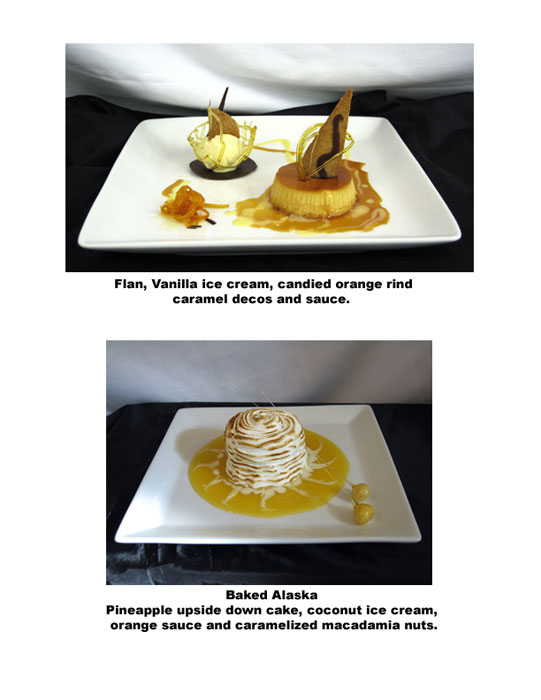
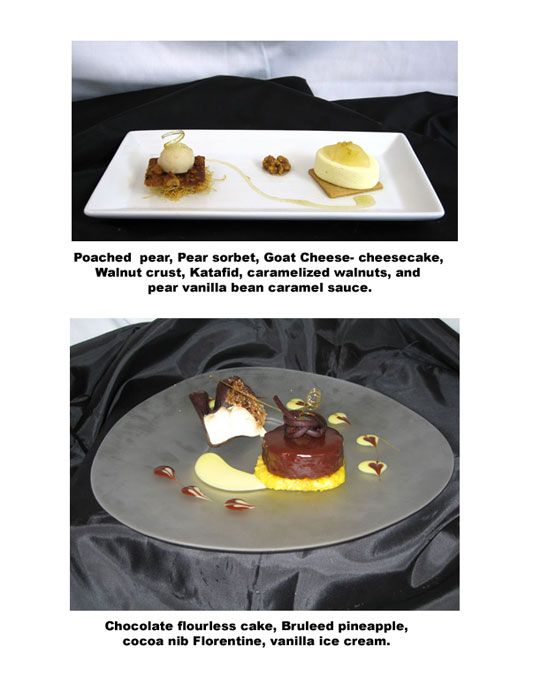
Here are the other plates I have made in this class.
Jackie
Quote by @%username% on %date%
%body%